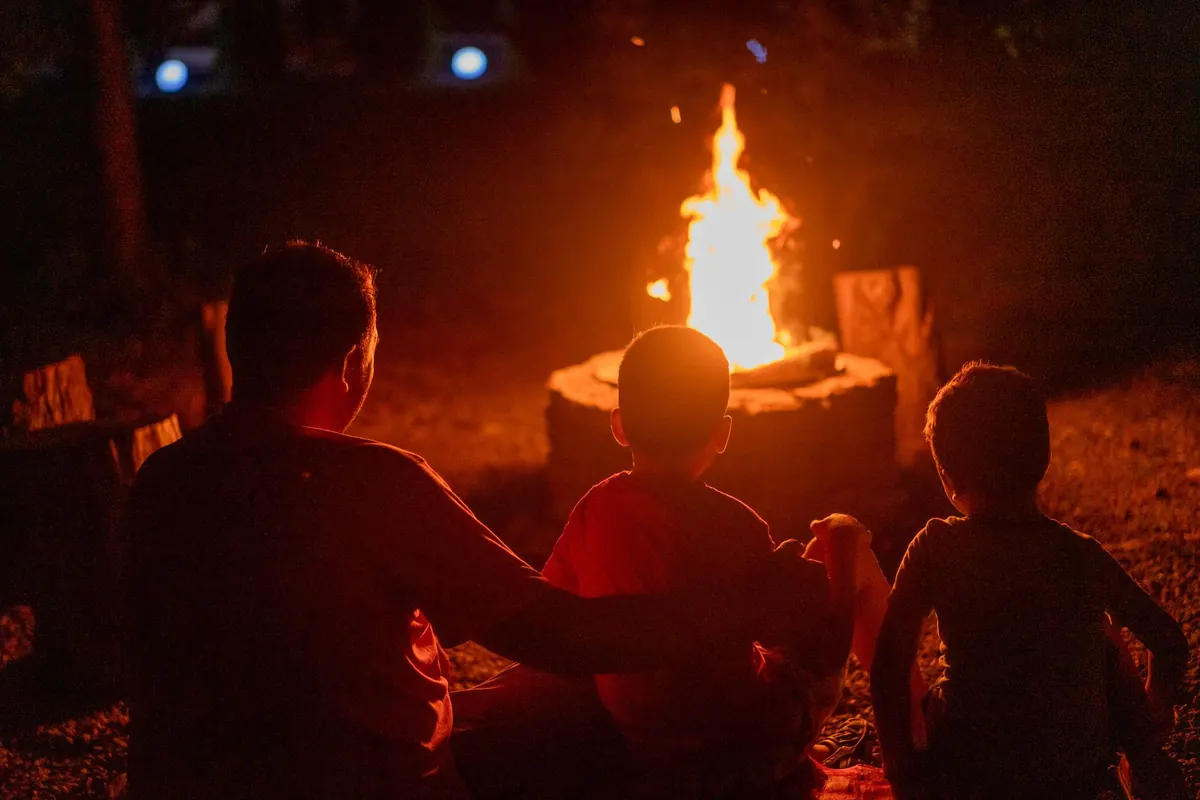
Ask three people in a Wyoming bar to tell you a frontier story and you will get three different kinds of tale. One grows taller with every retelling. One ends with a warning and a glance at the door. One is really about someone's grandfather and a winter nobody can agree on. All three belong to the same family, and the differences between them are not fussy academic distinctions. They tell you what the story wants from you: a laugh, a shiver, or a piece of local memory worth carrying.
What Counts as a Frontier Tale
A frontier tale is any story set at the moving edge of settlement, where ordinary rules are thin and help is a long ride away. The setting does not have to be desert. Logging camps, mining towns, prairie homesteads, river landings, and cattle trails all produce the same material, because the conditions are the same: distance, scarcity, and a decision that shows what a person is made of.
Three ingredients show up again and again. Distance, so the consequences of a choice arrive slowly. Scarcity, whether of water, ammunition, daylight, or trustworthy men. And a moment of judgment, where someone chooses and the story turns on that choice. Take away all three and you have a description of a place rather than a tale about it.
It helps to separate the frontier tale from the Western as most people meet it on screen. The filmed Western is a descendant: more stylized, more interested in silhouette and showdown. The tales kept in family kitchens and county histories are older and messier, told by people who knew the weather personally.
The Forms You Will Meet Most Often
Five shapes cover most of what gets told. Once you can name them, half the work is done.
The Tall Tale
Exaggeration is the engine, not the decoration. Paul Bunyan and Pecos Bill are the famous examples, but the form lives at smaller scale: the trout as long as a canoe, the winter so cold the words froze in the air. The telling is deadpan, the measurements are absurd, and there is usually no moral at all. If a story gets bigger each time you hear it, you are in tall-tale country.
The Campfire Legend
This one is anchored to a real place you could drive to. The phantom herd on the ridge, the light in the empty schoolhouse, the rider who asks directions and then is not there. Its signature is borrowed authority: it happened to a friend of a friend, in a named canyon, in a year that is close but vague. Legends rarely resolve. They stop, and the listener is left holding the unfinished end.
The Outlaw Ballad
Sung rather than spoken, in short repeated verses, often about a real death. "Jesse James" and "Sam Bass" are the well-known ones, but nearly every county has a locally famous verse or two. Listen for named places, a refrain, and a strange sympathy for the outlaw that sits alongside the moral tacked on at the end. The tune carries the memory; the words are almost secondary.
The Ordeal Narrative
Captivity narratives, blizzard survivals, wagon crossings, the night on the river. These are told in the first person or close to it, in sequence, with a great deal of physical detail about what was eaten and how the hands felt. They end in testimony and often in gratitude. Where the tall tale inflates, the ordeal narrative insists on accuracy, because the teller wants you to believe it.
The Local Anecdote
How the town got its name. Why the road bends at the creek. Who shot the sheriff's dog and what it cost him. These are short and shaped like a joke even when they are not funny. They are the currency of local identity, and the form most likely to be repeated word for word, because the wording is the joke.
Tropes: The Recurring Furniture
Tropes are not a sign of laziness. They are the handles that let a listener recognize a story quickly, and tellers reach for them the way a carpenter reaches for a familiar chisel. Learn them and you can follow a tale told in a dialect you have never heard.
- The stranger with an unnamed past. He arrives at dusk, works well, answers nothing. His silence is the plot.
- The last-chance stand. A narrow place, a dwindling supply, a decision to hold rather than run.
- Weather as antagonist. Not background but an opponent with intentions. The blizzard, the drought, the flood that arrives at the worst hour.
- The code of the open door. Hospitality tested. Who gets fed, who gets turned away, and what it costs to break the custom.
- The lying landmark. A false trail marker, a map drawn by a man who wanted to be rid of you.
- The animal that knows more than the people. A horse that refuses the ford, a dog that will not enter the cabin.
- The woman who outlasts the men. Frequently the only person in the story who keeps a clear head and a full kettle.
- The town that dies twice. Boom, bust, and the ghost that remains. Common wherever ore or timber ran out.
Notice that most of these are about scarcity and trust rather than gunplay. The quick-draw duel is largely a later invention, imported from cheap fiction and then exported to film. When you find it in an old oral tale, it usually means the story has passed through print.
How to Tell Them Apart
When a story is told to you live and you are not sure what you are hearing, ask yourself a short series of questions. They work as well on a porch in Texas as they do in a library.
- Does it grow with each telling? Then it is a tall tale, and the details are supposed to drift.
- Can I point to the place on a map? If the location is precise and the event is not, you have a legend.
- Is there a tune? A ballad will survive being sung badly, and often does.
- Is there a date and a sequence? Ordeal narratives hoard chronology the way misers hoard coins.
- Who benefits if you believe it? Anecdotes about local founders usually serve the family that still lives there.
Listening for the Frame
Storytellers announce their form before they reach the story. "They say" begins a legend. "I was there, and I will tell you" begins an ordeal. "Now, my uncle was a truthful man, mostly" is a warning that a tall tale is coming, delivered with a straight face. These openers are formalities, and skipping them is like skipping a handshake.
Delivery carries information too. A tall tale is told flat and fast, with no pause for you to question the numbers. An ordeal narrative slows down, repeats, gets the order of events exactly right. A ballad changes the room: people stop interrupting and start joining in on the last line of each verse.
One caution for anyone writing these down. Heavy phonetic spelling of dialect dates a story within a decade and makes it nearly unreadable a generation later. A light touch, one or two markers of speech and then plain prose, keeps the voice without turning the teller into a curiosity.
A Short Practice Routine
The quickest way to learn these forms is to retell one of each. Pick a tale you have heard more than twice. Write its bones in five lines, no more. Then name the form out loud: tall tale, legend, ballad, ordeal, anecdote. If the label feels wrong, that is useful information, and it usually means the story is a blend, which is normal in a family that has been telling it for a hundred years.
Next, keep one concrete detail and cut the rest of the decoration: the brand on the horse, the taste of the water, the exact number of miles left. Concrete details are what make a listener lean in, and they are also what make a story checkable, so use them honestly.
Finally, test the ending. A good frontier tale lands on a turn, not a summary. If your version closes with a sentence explaining what it all meant, cut that sentence and see whether the story still stands. It usually does, and it stands better.
And when you hear a story worth keeping, ask before you record it. Most tellers are pleased. Some are not, and the custom of the open door runs both ways.
Photo: Ahmet Polat / Pexels